


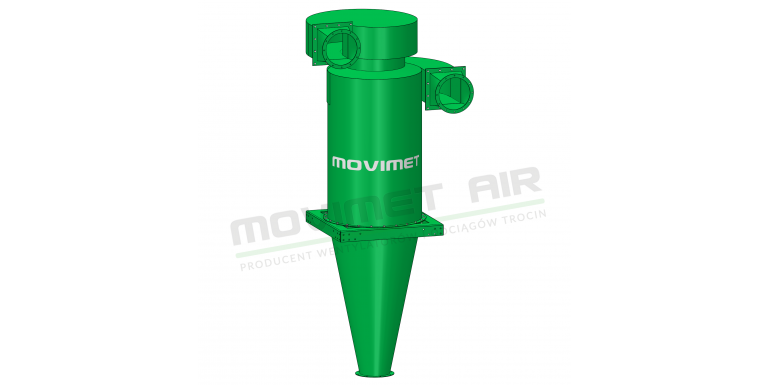
Filter cyclones in the wood processing industry - are they worth using?
In the wood processing sector, where significant amounts of dust and sawdust are constantly generated, effective dust removal is one of the key elements of the production infrastructure. Among the technical solutions available on the market are so-called filter cyclones - devices that combine the function of a cyclone and fabric filter in a single housing. Although this solution is sometimes perceived as compact and economical, in operational practice it exhibits a number of significant limitations. This paper outlines the main disadvantages of filter-cyclones and identifies the advantages of an alternative solution in the form of separate cyclone and filter modules.
Operational limitations of filter-cyclones
1 Difficult maintenance and service
One of the most serious problems associated with the use of filtrocyclones is limited access to the filter elements. Due to the compact, compact design, maintenance activities - such as inspection, cleaning and filter replacement - are much more time-consuming and cumbersome than with separate filter units.
2 No selective replacement of components
Unlike separated systems, a filter cyclone is an integrated unit in which the individual components (cyclone and filter) form a structural unit. If one of the components wears out, it is often necessary to interfere with the entire system, which increases operating costs. In a classic separate system, it is possible to replace only worn parts - such as cyclone components - which translates into greater service flexibility and lower maintenance costs.
3 Limited upgrade possibilities
Filter cyclones, due to their design, are difficult to adapt to changing technological conditions, such as an increase in the efficiency of the dust collection system, a change in the dust fraction or environmental requirements. In the case of split systems, it is much easier to expand the plant - for example, by adding a filter module or modifying the cyclone itself - without having to replace the entire system.
4 Lower separation efficiency in some applications
For processes that generate very fine dust (e.g., MDF wood sanding or composite material processing), the dust load may be too high for the filter cyclone. This is because the cyclone's dimensional proportions need to be disturbed to accommodate the filter cartridges, which reduces the efficiency of the first separation stage (i.e., centrifugal force-based separation). As a result, more dust goes directly to the filters, which - due to the limited filter area - may not be able to keep up with regeneration, leading to faster wear and a decrease in system performance.
The alternative: separate cyclone and filter station
Separating the cyclone and filtration functions into two independent modules provides a solution that eliminates many of the limitations mentioned above. Among the most important advantages of such a configuration are:
- ease of service access - filters can be quickly inspected and replaced without dismantling other parts of the system,
- scalability and upgradeability - the installation can be flexibly adapted to the changing needs of the plant,
- adaptation to the type of materials being dusted - independent selection of cyclone and filter parameters is possible,
- greater energy and filtration efficiency - these systems offer a larger filtration area and the possibility of using filters with a higher efficiency class (e.g., class M or H).
Summary
Although filter cyclones may find application in certain conditions - especially where space saving is important - in industrial practice they are increasingly proving to be a solution with limited flexibility and high operating costs. They work well in those industries where the amount of solid fraction or dust is small relative to the volume flow of air. However, in the woodworking industry, due to the aspects indicated above, they are rarely used and are not recommended by us. Separate cyclone and filter systems, due to their modularity, better operating ergonomics and greater upgradeability, are in many cases a better choice for woodworking plants looking for durable, scalable and efficient dust collection systems.