


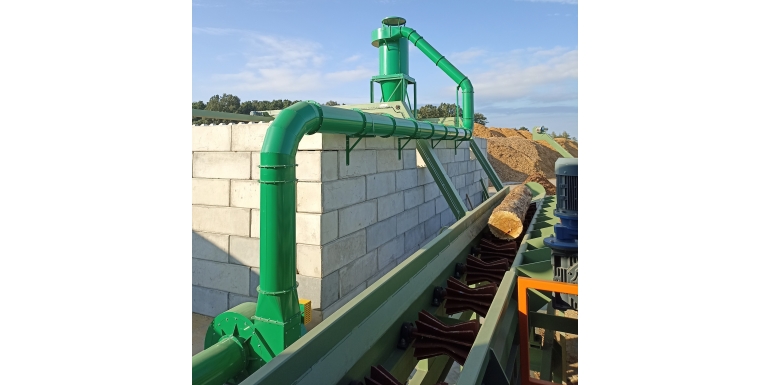
How to make sawdust extraction (lift)?
Modern sawmills, pallet makers, carpentry shops and workshops are increasingly focusing on efficiency and health and safety aspects. Therefore, sawdust extraction is becoming an indispensable piece of equipment. Such a system not only helps keep things tidy, but also enables material recovery and protects the health of workers by minimizing the risk of dust inhalation. What's more, it reduces the risk of fire - a key aspect in places where wood plays a major role.
How does sawdust extraction work?
Sawdust extraction is a system that removes wood particles (such as sawdust, shavings, chips) and airborne dust from places where they originate, such as workshops or production halls, and then transports them to tanks, silos, big-bags, truck containers or for further processing (such as wood pellet production lines).
Basic components of a sawdust extraction system
Sawdust extraction (dust collection) systems usually consist of several key components that together form an efficiently functioning whole:
- Cyclone and/or filter (filter station, dust collector) - separates the sawdust from the air, thus allowing the material to be released into the tank without blowing,
- Piping system - allows efficient transportation of sawdust. The cross-sections of the installation must be selected in such a way as to maintain an adequate air velocity at each point of the installation, ensuring the lifting of the material without excessive pressure (power) losses.
- Transport fan ("blower" for sawdust)- generates the appropriate pressure difference and air flow necessary to lift sawdust, shavings and dust into the pipeline.
- Target valve (target sluice, target feeder)-provides pressure separation between plant components such as the cyclone, filter or hopper and the external environment, allowing material to flow through.
- Block catchers(grippers) - in process lines where there is a risk of falling blocks, scraps and other large components, block catchers are used to protect the fan, cell airlock and other components from damage.
- Fire and explosion protection systems - depending on the degree of danger and the investor's requirements, various types of protection are used, such as dry risers, spark detection and extinguishing, backflow preventers, decompression panels, explosion suppression systems, equipment made in accordance with the ATEX directive.
Understanding the function of each of these components is the foundation needed to create an efficient and reliable extraction system. The devil is in the details, so take the time to carefully plan every aspect of the system. Particularly important is the correct selection of pipeline cross sections, fan power and pressure characteristics, and cyclone size.
Types of sawdust extraction equipment
Selecting the right sawdust extraction device is a key step. Depending on the nature of the work, solutions with different durability and performance are available. Leaving aside solutions imported from China, fans are available in standard and heavy-duty versions. Similarly, pipelines are available in lightweight versions (0.7-1.0 mm thick galvanized steel pipes) and heavy-duty versions (welded pipes made of structural steel or Hhardox steel, usually with wall thicknesses of 2 mm or more). Pipelines in the light version are commonly used for the extraction of fine dust, mainly in carpentry shops, while pipelines in the heavy version are typically used in sawmills, plants producing pallets, wood pellets, wood chips, garden accessories, etc. The market offers both stationary sawdust extraction and mobile systems that can be customized. Each of these variants has its own advantages and limitations, so it is worthwhile to carefully analyze your needs in order to choose the solution best suited to your individual requirements.
Stationary or mobile extraction - which better suits your needs?
The decision between stationary and mobile extraction depends on the nature of the work and available space. Here is a comparison of the two solutions:
| Type of extraction | Advantages | Disadvantages |
|---|---|---|
| Stationary | High efficiency, designed to handle multiple machines simultaneously, fixed installation for convenience of use. | Requires more space, less flexible for changing needs. |
| Mobile | Compact design, easy to move, flexibility to adapt to current tasks. | Less efficient compared to fixed systems, may be less convenient for intensive work. Usually supports one or two workstations. |
The choice depends on the size of the workshop, the type of work to be done and how the waste is further processed. For larger sites, a stationary extractor will usually be a better choice, while for smaller workshops, a mobile one.
How to plan the sawdust discharge site?
Planning the sawdust discharge site is a step that is often overlooked, and wrongly so. A well-designed dump site can significantly improve the efficiency of the system and facilitate waste management. Here's what to consider:
- Space availability - make sure the drop site is easily accessible.
- Expandability - our experience shows that often, as plants expand, material from subsequent production lines is introduced into the same sawdust hopper using separate construction sawdust extraction systems.
- Distance from processing machines - the shorter the distance from the sawdust discharge point to the outermost machine, the lower the flow resistance of the system and the pressure demand generated by the fan.
- Distance from the border of the plot and neighboring buildings - due to the noise generated and dust (especially in installations not equipped with filters), it is recommended to distance the sawdust discharge site from the border of the plot to meet acceptable emission standards and not cause nuisance to neighbors.
The most common problems and their solutions
How to deal with clogging of sawdust extraction?
The problem of sawdust extraction clogging occurs most often in poorly designed sawdust extraction installations or in installations with alternating operation of machines, where the amount of air is not properly balanced with gates (dampers). Since this is a complex issue, we will not describe it in detail here - feel free to contact us so that we can discuss your specific problem. Another group of problems are blockages caused by large elements (scraps, pads) that have unwantedly entered the installation - in that case we recommend looking at our range of pad catchers.
How to deal with abrasive wear of sawdust extraction components?
In addition to the obvious method, i.e. replacing worn elements with new ones, there are a number of other ways to deal with abrasive wear, including
- The use of elements with a thicker wall;
- Use of components made of HARDOX/RAEX wear-resistant steel. Note - some manufacturers boast of using Hardox steel in standard products, but these are the variants with the lowest hardness, usually welded in the wrong way causing brittle fracture or improper microstructure weakening the material;
- The use of vacuum or ejector (injector, jet) installation, where the fan does not pump the transported medium;
- The use of elbows with a larger radius of deflection of the axle and run-out elbows (with an extended straight section);